New Góra Parkowa Observation Tower in Krynica-Zdrój: What to See in Two Days in 2026
Krynica-Zdrój, a historic spa town in southern Poland’s Beskid Sądecki Mountains, has gained a major new attraction for 2026. On 17 January, a 36-metre observation tower officially opened on Góra Parkowa, offering panoramic views of the resort, surrounding mountain ranges and, in favourable weather, the distant Tatra Mountains. The tower adds a modern viewpoint to a destination already known for its mineral springs, elegant architecture, forest walks and mountain excursions. A two-day visit provides enough time to enjoy the new attraction, explore Krynica’s traditional spa district and experience the natural surroundings without rushing between locations. This itinerary covers the essential sights, practical admission information, transport options and a realistic schedule for a weekend in Krynica-Zdrój.
Day One: Góra Parkowa Observation Tower and the Historic Spa Centre
Begin your first morning on Góra Parkowa, the wooded hill overlooking central Krynica-Zdrój. Its summit stands approximately 742 metres above sea level, but reaching it does not require a demanding mountain hike. A historic funicular railway connects the spa district with the upper station, making the attraction convenient for families, older visitors and those travelling without hiking equipment. The railway dates from 1937 and retains much of its pre-war character, including restored carriages and period-inspired surroundings. Visitors who prefer walking can follow marked trails and park paths from the town centre, generally allowing 40–50 minutes for the ascent. The railway is the easier option, particularly if you plan to spend the afternoon visiting other attractions.
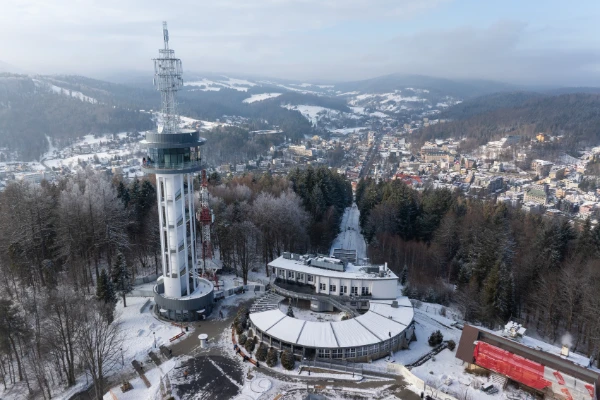
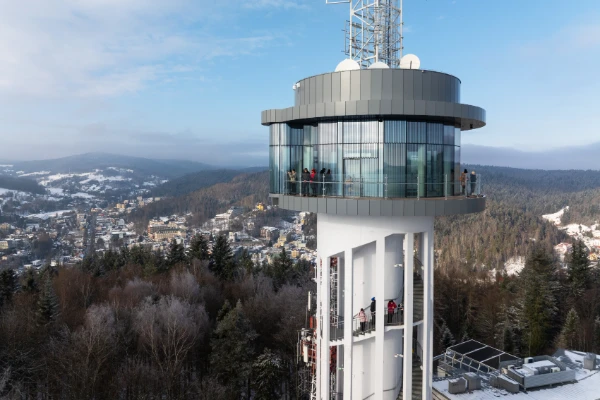
The new observation tower is the main reason to visit Góra Parkowa in 2026. Developed by Polskie Koleje Linowe (PKL), the 36-metre structure combines a modernist design inspired by the resort’s architectural heritage with practical features for year-round sightseeing. Its upper level contains a glazed viewing area, an outdoor observation terrace and a semicircular glass-floored skywalk. An internal lift provides access to the sixth floor, while visitors who prefer stairs can climb 216 steps. From the top, the landscape includes the buildings of Krynica-Zdrój, forested slopes of the Beskid Sądecki, Jaworzyna Krynicka and distant mountain ridges. The Tatras may also be visible when the atmosphere is particularly clear, although clouds and haze frequently limit long-distance views.
Allow approximately 60–90 minutes for the tower and the immediate summit area, extending your visit if you want to explore the nearby attractions. The tower charges a separate admission fee from the funicular: the published 2026 prices are PLN 15 for a standard ticket and PLN 10 for a concession ticket. Tower tickets are available at the upper-station ticket office rather than through the ordinary railway ticket. During the low season, an adult funicular return ticket costs PLN 29 online or PLN 35 at the ticket office, while high-season online return tickets cost PLN 35. Opening hours vary, and tower admission normally closes 30 minutes before the end of railway operations. Check the PKL timetable before travelling, particularly during maintenance periods, when the railway may be temporarily suspended even though the observation tower remains accessible.
What Else to See on Góra Parkowa Before Returning to Town
The observation tower is only one part of the renovated Góra Parkowa leisure area. Around the upper station, PKL has restored elements of the resort’s 1930s atmosphere through period-style interiors, historical displays and exhibitions recalling Krynica’s popularity between the world wars. The development includes the Polana Muzyki i Światła, or Meadow of Music and Light, which provides a family-friendly recreational space and seasonal illuminated displays. The Rajskie Ślizgawki slides recall earlier sledging traditions and offer an additional activity when operating conditions permit. The hilltop also has terraces and refreshment facilities where visitors can enjoy a break before heading downhill.
Take particular notice of the historical material displayed around the tower and railway buildings. Illuminated archival photographs show how Góra Parkowa and the surrounding spa town looked in earlier decades, while recorded commentary provides context about the region’s history and scenery. Inside the tower’s glazed observation area, visitors can sit down and enjoy the view without remaining exposed to wind or cold. The glass-floored skywalk offers a different perspective, although its limited capacity can create short queues at busy times. According to PKL’s visitor rules, the tower accommodates up to 50 people at once, while no more than five people may occupy the skywalk simultaneously. Those travelling with pushchairs should be aware that pushchairs are not permitted on the outdoor terrace, although a designated storage area is provided inside.
After visiting the summit, return towards Krynica’s centre through the landscaped paths of Park Zdrojowy, the historic spa park surrounding Góra Parkowa. The wooded slopes contain walking routes of different lengths, making it possible to adapt the descent to the weather and your energy levels. In warmer months, the mixture of mature trees, shaded paths and occasional viewpoints provides a quieter alternative to the busy central promenade. During autumn, the foliage adds colour to the hillside, while winter visitors should expect potentially slippery surfaces. If you have already walked uphill, taking the funicular down is a sensible way to preserve time for the spa district. Aim to reach the centre around lunchtime, leaving the afternoon for mineral waters, local history and the town’s distinctive architecture.
Afternoon in Krynica-Zdrój: Mineral Springs, Architecture and Local Culture
Once back in central Krynica-Zdrój, start with the Main Pump Room, known locally as Pijalnia Główna. This important spa building stands beside the main promenade and reflects the town’s long association with mineral-water treatment. Krynica became one of Poland’s prominent health resorts because of its naturally occurring mineral waters, including varieties traditionally associated with names such as Zdrój Główny, Słotwinka and Jan. The waters differ in mineral composition, flavour and intended use, so they should not be treated as interchangeable refreshments. Visitors can sample available varieties and learn about the resort’s spa traditions, although anyone following medical advice about sodium intake, kidney conditions or digestive disorders should check whether particular mineral waters are suitable. A stop of around 30–45 minutes is usually sufficient.
Continue along the pedestrian-friendly promenade and Bulwary Dietla, where much of Krynica’s architectural heritage is concentrated. The historic Stary Dom Zdrojowy, or Old Spa House, dates from the late nineteenth century and represents the period when the resort attracted wealthy visitors from across the region. Nearby historic villas illustrate the mixture of timber construction, decorative balconies and resort architecture characteristic of the Carpathians. The central district is also associated with Jan Kiepura, the internationally recognised Polish tenor who helped establish Krynica’s reputation as a cultural destination. Rather than treating this area as a quick photo stop, allow time to examine the buildings and follow the promenade towards the older streets. The contrast between these traditional spa structures and the new tower on Góra Parkowa is one of the defining features of a visit in 2026.
For lunch or an early evening meal, choose a restaurant in the central spa district rather than travelling to another part of town. Regional menus may include pierogi, potato-based dishes, soups and foods associated with the culinary traditions of Lesser Poland and the Carpathian borderlands. Accommodation is also particularly convenient near the promenade, where guests can reach the funicular, pump rooms and most historic attractions on foot. A centrally located hotel or guesthouse reduces the need for repeated car journeys, especially on a short weekend. During school holidays, summer weekends and winter skiing periods, booking ahead is sensible because Krynica attracts both spa visitors and outdoor enthusiasts. Leave approximately one hour for lunch before the final cultural stop of the day.
Nikifor Museum and an Evening Walk Through the Resort
The Nikifor Museum is one of Krynica-Zdrój’s most worthwhile cultural attractions, especially for visitors interested in Polish art and the town’s social history. Located in the historic Romanówka villa on Bulwary Dietla, the museum is dedicated to Nikifor Krynicki, also known as Epifaniusz Drowniak, the self-taught painter closely associated with the resort. His paintings frequently portray churches, railway stations, buildings and imaginary urban scenes, often combining careful observation with highly individual interpretations. Nikifor spent much of his life working in poverty, yet his art eventually gained recognition well beyond Poland. The museum places his work within its historical setting and gives visitors a more personal understanding of Krynica than a conventional sightseeing walk alone.
Plan approximately one hour for the museum and arrange your itinerary around its published opening times. Under the schedule listed for 2026, the museum is normally open on Tuesdays, Wednesdays, Fridays and Saturdays from 10:00 to 13:00 and 14:00 to 17:00, with shorter hours on Thursdays and Sundays. It is closed on Mondays and certain public holidays. Since May 2026, standard admission has been PLN 24 and concession admission PLN 19, while Thursday is designated as a free-admission day. These details make the museum particularly easy to incorporate into a weekend visit, although a Sunday itinerary should place it earlier because closing time is normally 15:00. Visitors staying only one night should therefore consider which day is best for the museum before fixing their other activities.
Spend the evening around the promenade, enjoying Krynica at a slower pace once the daytime excursion groups have departed. The spa district is compact enough for an informal walk between its historic buildings, cafés and landscaped public spaces. If the weather is mild, the illuminated streets and surrounding hills offer an attractive setting for photography. During colder months, choose a comfortable indoor café and save longer outdoor walks for daylight. An overnight stay near the centre is especially practical if you intend to visit Słotwiny Arena the following morning, since this attraction lies outside the immediate pedestrian spa district. By the end of the first day, you will have visited the new observation tower, experienced the historic funicular, sampled Krynica’s spa traditions and gained an introduction to the town’s artistic heritage without needing a car for most of the route.
Day Two: Słotwiny Arena, Mountain Views and Practical Travel Planning
Dedicate the second morning to Słotwiny Arena, a mountain recreation area north-west of central Krynica-Zdrój. Its principal sightseeing attraction is a wooden observation tower connected to a long elevated walkway through the forest canopy. This is a different structure from the new Góra Parkowa tower: Słotwiny Arena’s viewpoint opened in 2019 and rises to 49.5 metres, while the educational walkway extends for approximately 1,030 metres. Visitors travel gradually upwards along the wooden route, passing interactive displays about local wildlife, forests and regional culture. The setting among beech, fir and spruce trees makes the experience particularly attractive during late spring, summer and autumn. Travellers with children should allow extra time for the educational installations and frequent stops for photographs.
Słotwiny Arena can be reached from the town centre by car, taxi or available local transport, with access arrangements depending on the season. The attraction is located at Słotwińska 51A, and visitors can approach the upper area on foot or use a chairlift when it is operating for sightseeing. The wooden tower and its walkway are designed for a gradual ascent, providing an alternative to climbing a conventional staircase. Allow two to three hours for the excursion, including the journey, ticket arrangements, walking route and viewpoints. Check the attraction’s official website before departure for operating dates, chairlift availability and current admission prices. Seasonal weather, especially snow, ice or strong winds, can affect access and the availability of additional activities such as the slide.
Visitors seeking a longer mountain excursion could instead dedicate the second day to Jaworzyna Krynicka, one of the best-known summits in the Beskid Sądecki. Rising to 1,114 metres above sea level, Jaworzyna is accessible by gondola from the Czarny Potok area and offers walking routes and mountain scenery, subject to seasonal operating arrangements. It is best treated as an alternative to Słotwiny Arena rather than an extra compulsory stop, since combining both destinations with a relaxed town visit can make a two-day trip unnecessarily rushed. An important development in 2026 is the construction of the Krynica Express gondola connection between the resort centre and the Czarny Potok area. Work began in October 2026, but the new connection is scheduled to open in autumn 2027, so visitors travelling in 2026 should not expect to use it.
How to Organise a Comfortable Two-Day Visit in 2026
A practical weekend schedule is to spend the first morning on Góra Parkowa, the afternoon around the Main Pump Room and Nikifor Museum, and the evening in the historic centre. On the second day, leave after breakfast for Słotwiny Arena or Jaworzyna Krynicka, returning to Krynica in time for lunch and departure. Visitors travelling by car will generally have greater flexibility for the second day’s mountain excursion, while those arriving without a vehicle may find a local taxi or scheduled transport more convenient. Krynica-Zdrój has rail and bus connections, although journey times and services depend on the departure location and timetable. The town is situated in Lesser Poland, south-east of Nowy Sącz, with mountain roads that require additional care during winter conditions.
For budgeting, remember that the new Góra Parkowa tower and the funicular require separate tickets. Based on the published 2026 low-season prices, one adult purchasing a return funicular ticket online for PLN 29 and a standard tower ticket for PLN 15 would spend PLN 44 on these two attractions. During the high season, the equivalent combination costs PLN 50 when using the published online funicular fare. Walking up and down Góra Parkowa eliminates the railway cost but not the tower admission fee. Additional expenses may include the Nikifor Museum, meals, accommodation, local transfers and the separate admission arrangements at Słotwiny Arena. Families should compare concession conditions carefully rather than assuming every attraction applies the same age limits. Carrying a payment card and some Polish złoty is useful, particularly when purchasing tickets at individual attraction offices.
Seasonal planning can make a substantial difference to the trip. Late spring and early autumn usually provide comfortable conditions for walking, while summer offers longer daylight hours and greater opportunities for outdoor sightseeing. Winter transforms the hills around Krynica into a skiing destination, but shorter days and variable visibility can affect panoramic views. In 2026, the Góra Parkowa funicular has a scheduled technical closure from 19 October to 6 November, while PKL indicates that the observation tower and certain upper-station attractions remain available. During such periods, reaching the summit on foot may be necessary. Before setting off, consult the official websites of PKL, Słotwiny Arena and the local tourist information service for the latest opening hours, weather-related changes and visitor rules. With a realistic schedule, the new observation tower becomes the centrepiece of a rewarding two-day visit that also leaves room for Krynica-Zdrój’s mineral waters, art, architecture and mountain landscapes.