From Bielsko-Biała to Ustka by Pendolino: From the Mountains to the Baltic Sea in One Day
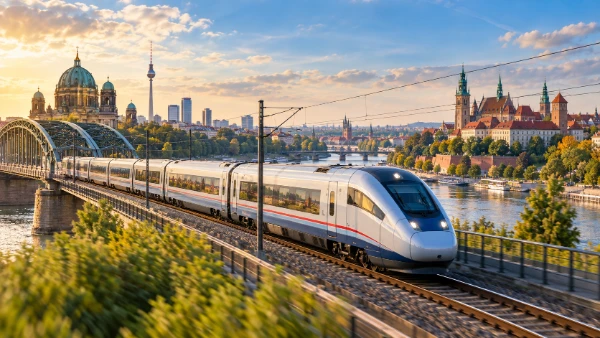
Travelling from Bielsko-Biała at the foot of the Beskids to Ustka on the Baltic coast used to mean accepting either a long drive or a railway journey with changes along the way. Summer 2026 has brought a much simpler option. PKP Intercity extended an Express InterCity Premium service beyond Gdynia to Ustka, creating a direct Pendolino connection between southern Poland and the central Baltic coast. The journey crosses a remarkable section of the country in a single day: passengers leave a city framed by the Beskid landscape, pass through Upper Silesia and Warsaw, continue across northern Poland and the Tricity, and reach Ustka in the evening. The service is particularly useful for holidaymakers carrying luggage because there is no need to change trains in Warsaw, Gdynia or Słupsk. It is important, however, to treat it as a seasonal 2026 connection rather than a permanent year-round service.
The Direct Bielsko-Biała–Ustka Pendolino in Summer 2026
The direct connection is one of the notable additions to Poland’s summer 2026 railway timetable. PKP Intercity extended its existing Express InterCity Premium service from Bielsko-Biała towards Gdynia so that selected summer journeys continue all the way to Ustka. The first Pendolino reached the Baltic resort on 27 June 2026, marking the first regular use of this type of train on the route to Ustka. The seasonal arrangement was announced for the main holiday period through the end of August. This distinction matters when planning an autumn, winter or spring journey: outside the summer timetable, passengers should not assume that the same direct EIP connection will remain available and should check the current PKP Intercity schedule for the chosen date.
Under the main summer timetable, EIP 4852 leaves Bielsko-Biała Główna at about 11:47 and reaches Ustka at approximately 20:21. The scheduled journey is therefore around eight hours and thirty-four minutes, allowing passengers to travel from southern Poland to the Baltic within the same calendar day without changing trains. Minor variations can appear on individual dates when railway timetables are corrected, and departure or arrival times may shift by several minutes. Anyone travelling on a fixed date should therefore check the journey again shortly before departure rather than relying on a time saved several weeks earlier. The direct service is especially valuable because a connection lasting more than eight hours becomes considerably less tiring when luggage and passengers can remain on the same train throughout.
The route also provides a useful cross-section of Poland’s main railway network. After leaving Bielsko-Biała, the train calls at Czechowice-Dziedzice, Pszczyna, Tychy, Katowice, Sosnowiec and Zawiercie before heading towards Warsaw. It serves Warszawa Zachodnia, Warszawa Centralna and Warszawa Wschodnia, then continues north through Iława, Malbork and Tczew. The final part of the journey includes Gdańsk, Sopot and Gdynia, followed by Lębork and Słupsk before the train reaches Ustka. For passengers travelling the entire distance, these stops make the changing geography particularly noticeable: the journey begins close to the Beskids, crosses the country’s largest urban areas and eventually finishes only a short distance from the Baltic shore.
Why a Direct Train Makes Such a Long Journey Easier
The main advantage is not simply speed but continuity. A journey from Bielsko-Biała to Ustka covers a large part of Poland, and connections requiring a change can become awkward when a passenger is travelling with a suitcase, beach equipment, children’s luggage or several bags. A direct Pendolino removes the need to leave one train, find the correct departure track at a large station and move the luggage again. That is particularly helpful in Warsaw and the Tricity, where stations are busy during the summer holiday season. It also reduces the consequences of a modest delay on the first part of a journey, since there is no separate onward train to miss.
The timetable is also practical for travellers who prefer not to begin a holiday before dawn. A departure around midday leaves enough time to reach Bielsko-Biała Główna from the city centre or surrounding Beskid towns without an exceptionally early start. The trade-off is an evening arrival in Ustka. A scheduled arrival shortly after 20:00 means this is best understood as a travel day rather than a full sightseeing day at the seaside. Passengers booking accommodation should make sure that evening check-in is possible and allow additional time in case the train reaches Ustka later than planned. For a longer Baltic holiday, however, losing only one day to a direct journey can be a reasonable compromise.
The reverse service also demonstrates why the connection works better for a holiday or overnight stay than for a same-day excursion. During the summer timetable, the Pendolino from Ustka leaves in the morning, at around 07:23, and reaches Bielsko-Biała during the afternoon. This makes it possible to travel in either direction within one day, but not realistically to make a return trip from Bielsko-Biała to Ustka and back on the same date. Anyone hoping to spend time on the beach, walk around the harbour or visit the town should plan at least one night in Ustka. The phrase “in one day” therefore describes the complete northbound journey, not a day trip with several hours at the coast.
What the Journey Is Like from the Beskids to Northern Poland
Bielsko-Biała provides an appropriate starting point for a journey described as travelling from the mountains to the sea. The city lies beside the Silesian and Little Beskids, and the surrounding hills are a constant part of its identity even though the railway station itself is in the urban centre. After departure, the train quickly passes through Czechowice-Dziedzice and Pszczyna before entering the more densely developed part of Upper Silesia. Stops in Tychy, Katowice and Sosnowiec mean that the same train also serves passengers from one of Poland’s largest urban regions. For someone completing the entire route, the first few hours show how quickly the landscape changes from the southern foothills to the industrial and metropolitan areas farther north.
Warsaw marks roughly the central geographical stage of the journey and is one of the busiest sections of the route. The train calls at the western, central and eastern stations before continuing towards Iława. From this point, the atmosphere of the trip begins to change again. The route heads through northern Poland towards Malbork and Tczew, where the railway corridors lead into Pomerania. Passengers do not need to do anything during these major stops if their destination is Ustka: the same train continues north. This is worth remembering in Warsaw in particular, as several minutes at Warszawa Centralna may look like an opportunity to leave the train, but the stop is intended primarily for boarding and alighting rather than for passengers to take an extended break.
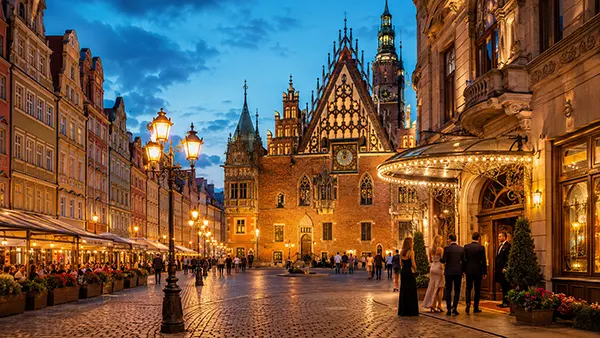
The Tricity section is one of the most recognisable parts of the final stage. EIP 4852 serves Gdańsk Główny, Gdańsk Wrzeszcz, Gdańsk Oliwa, Sopot and Gdynia Główna before turning towards Lębork and Słupsk. Travellers heading only to Gdańsk, Sopot or Gdynia can leave earlier, but Ustka passengers remain on board for nearly another two hours after central Gdańsk. Słupsk is the last major stop before Ustka and traditionally acts as an important transport hub for journeys to this part of the coast. The 2026 Pendolino extension removes that final change. Instead of leaving the long-distance train in Słupsk and completing the last section separately, passengers stay seated until the service reaches Ustka itself.
Comfort During an Eight-and-a-Half-Hour Pendolino Journey
An eight-and-a-half-hour railway journey is long enough for on-board conditions to make a meaningful difference. Pendolino services provide reserved seating, air conditioning and electrical power for passengers, while Wi-Fi is available on the train. The fixed seat reservation is useful on a summer route because passengers know where they will be sitting before boarding rather than competing for an unreserved place on a busy coastal service. First and second class are available, although paying for first class is not essential simply because the journey is long. For many travellers, a second-class reserved seat is entirely adequate, particularly when the trip is booked early enough to obtain seats that suit their preferences.
Food also deserves some planning because the journey covers lunchtime and most of the afternoon before reaching Ustka in the evening. Pendolino services include WARS catering, allowing passengers to buy meals and drinks during the journey. Even so, carrying water and a small amount of food is sensible, especially when travelling with children or following a particular diet. Railway catering can be useful for a hot meal or coffee, but relying on it for everything during an eight-hour journey leaves less flexibility. Eating before departure in Bielsko-Biała is another straightforward option, particularly for travellers who prefer to settle into their seat and avoid thinking about lunch during the first part of the journey.
A few simple choices can make the trip noticeably more comfortable without turning preparation into a complicated exercise. Keep documents, the ticket, phone and charger in a smaller bag rather than at the bottom of a large suitcase. A light extra layer is useful because air-conditioned railway carriages can feel cool even on a hot day. Headphones, a book or downloaded entertainment help during the long sections between major cities, while travellers intending to work should charge their devices before leaving in case they cannot immediately use a socket. Most importantly, pack so that the luggage can be handled independently. The advantage of a direct service is reduced if several heavy bags become difficult to move through the station at either end.
Tickets, Departure Planning and Arrival in Ustka
Ticket prices for Express InterCity Premium services are not best treated as a single fixed figure. PKP Intercity uses different price levels, and cheaper allocations can disappear as a train fills. Promotional fares for the new summer connection were advertised from PLN 59, but that figure should not be interpreted as a guaranteed price for every Bielsko-Biała–Ustka journey. During summer 2026, booking comparisons for the full route have also shown second-class prices of roughly PLN 240 or more on some dates. The practical rule is simple: check the actual fare for the day you intend to travel and compare nearby dates if your plans are flexible. For a popular summer weekend, buying earlier generally provides a better choice of seats than waiting until shortly before departure.
The easiest preparation is to buy the ticket in advance through an authorised PKP Intercity sales channel and keep the electronic ticket accessible on your phone. Because an EIP journey includes a specific seat reservation, check the carriage and seat numbers before boarding. There is no airline-style check-in, so arriving extremely early is unnecessary, but reaching Bielsko-Biała Główna around fifteen to twenty minutes before departure gives enough time to check the departure board, locate the correct track and board without rushing. On the morning of travel, check the current train information once more, particularly during periods of engineering work or timetable corrections. For a journey of this length, a ten-minute check before leaving home can prevent considerably more inconvenience later.
Arrival in Ustka is straightforward because the railway terminus is within the town rather than at an outlying transport interchange. The central streets, harbour and eastern beach can all be reached on foot, although the exact walking distance depends on the chosen accommodation and beach entrance. A typical walk from the railway station towards the eastern beach is around 1.5 kilometres, roughly twenty minutes at an ordinary pace. Travellers with light luggage may therefore have no need for additional transport. Those carrying large suitcases, travelling with small children or staying farther from the centre may prefer a local taxi. Because the Pendolino arrives in the evening, it is sensible to save the accommodation address and route before leaving Bielsko-Biała instead of working out the final walk after an eight-hour journey.
Making the Most of the First Evening and the Following Day in Ustka
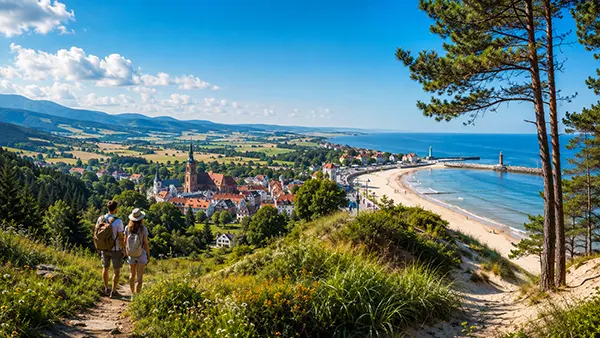
An arrival at around 20:21 still leaves time for a first look at central Ustka, particularly during the longest summer days, but the evening should not be overloaded with plans. After checking in, the harbour area is a natural choice for a short walk. Ustka’s waterfront brings together fishing and passenger vessels, the harbour entrance, the historic lighthouse, breakwaters and access to the beach. The town is compact enough for many central attractions to be reached on foot, which is helpful after a full day on the train. A simple evening meal and a walk by the sea are more realistic than trying to fit several attractions into the remaining hours.
The following morning gives a much better opportunity to see the coastal character of Ustka. The eastern beach is the most immediately accessible option from the central resort area, while the harbour separates it from the western side of town. The promenade, lighthouse surroundings and harbour quays can easily be combined in one walking route without needing a car. Ustka also works as a base for a longer stay on the central Polish coast, so the Pendolino connection is useful not only for conventional beach holidays but also for travellers interested in coastal walking, cycling and shorter trips around the Słupsk and Pomeranian region. The absence of a car is not a serious disadvantage for a stay focused on the centre, harbour and beaches.
The most important planning point is the seasonal nature of the direct train. The Bielsko-Biała–Ustka Pendolino is a specific summer 2026 service, not a connection that should automatically be expected throughout the year. Travellers heading to Ustka after the summer timetable ends may need a different PKP Intercity service or a connection involving a change, commonly via another northern Polish station. For journeys during the operating period, however, EIP 4852 offers an unusually simple way to cross Poland: board in Bielsko-Biała around midday, keep the same reserved seat through Katowice, Warsaw and the Tricity, and reach the Baltic coast in Ustka the same evening. For a distance of this scale, that simplicity is the strongest reason to choose the direct train.